
Who we are
About URRO
Uganda Reproduction Rights Organisation (URRO) is the collective management organisation for the people who write, illustrate and publish Uganda’s books, journals, newspapers and magazines. We look after their copyright, license others to copy their work, pay them the royalties that copying earns, and help keep pirated books off the market.
No author can keep track of every school, university or office that photocopies or scans their work. And no school can ask permission from every author whose pages it needs. URRO stands in the middle. One licence from us makes the copying lawful, and the money goes back to the people who created the work.
Today URRO represents 100 authors, 30 publishers and 5 associations with a combined membership of 3,230. We are a member of the International Federation of Reproduction Rights Organisations (IFRRO), which links us to sister organisations around the world.
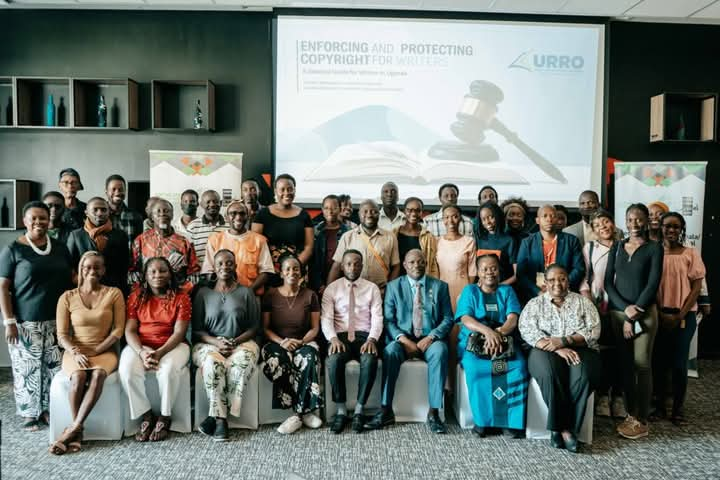
Our mandate
What gives URRO authority
URRO is regulated by the Uganda Registration Services Bureau (URSB) through its Department of Copyright and Neighbouring Rights. We work to the standards set by IFRRO, the World Intellectual Property Organization (WIPO), UNESCO and the African Regional Intellectual Property Organization (ARIPO).
Our authority comes from two places: the law, and our members. Each member signs a mandate, a written authorisation for URRO to manage the reproduction rights in their published works. The mandate is non-exclusive and does not transfer ownership of copyright. It simply lets us license, collect and enforce on the member’s behalf.
What the law says: URRO is registered as a collecting society under section 56 of the Act. Once a society is registered for a bundle of rights and category of works, the Registrar cannot register a second society for the same bundle and category. Under section 57, a collecting society collects royalties for its members or any other owner, and pays its members or any other owner who is the appropriate beneficiary. Section 80 confirms that a collecting society may enforce the Act on behalf of copyright owners.
Mission
To license the lawful copying of published works and deliver fair royalties to the authors and publishers who created them.
Vision
A reputable collecting society facilitating access to information through licensing, and safeguarding the investments of rightsholders in intellectual property in Uganda.
What we do
Mission, Vision & Values
Make it legal and simple to copy from copyright-protected works
Manage copyright collectively on behalf of creators and publishers
Maximise the return to writers, artists and publishers
Open membership: every eligible rightsholder may join, without discrimination
Equal treatment: members, non-members and foreign rightsholders are paid under the same rules
Balanced representation: authors and publishers each have a fair say
Member control: one member, one vote
Transparency and accountability: to members, users and the Registrar
Integrity: money collected for rightsholders is kept separate from our operating funds
Our history
How URRO was built
URRO grew out of the revival of book publishing in East Africa after the 1990s. In Uganda, that revival was championed by the National Book Trust of Uganda (NABOTU). More Ugandans were setting up publishing houses and more local writers were finding their way into print, so formal contracts were needed to protect everyone’s rights. And as educational publishing grew, so did the need to protect copyright.
In January 2010 WIPO, IFRRO and ARIPO held a regional Training on Collective Management of Literary and Artistic Works in Windhoek, Namibia. URSB nominated Mr Charles Batambuze, then Executive Secretary of NABOTU, to attend. On his return, and with support from IFRRO, NABOTU brought writers, publishers and journalists together for a workshop led by facilitators from URSB and the Uganda Performing Right Society (UPRS). The meeting agreed to form URRO.
An interim Board of nine was set up. Mr Martin Okia, a publisher, was Chairman and Ms Eva Mutongole Wamala, an author, was Vice Chairperson. The other members were Ms Evangeline Barongo a writer, Mr Dennis Muhumuza a print journalist, Ms Rosey Sembatya a fiction writer, Ms Beatrice Lamwaka a fiction writer, Mr Bonnetventure Asiimwe a visual artists, Mr James Wasula representing Songwriters through UPRS, and Mr Charles Batambuze. URRO was incorporated as a company limited by guarantee in 2010 and, as the law then required, also registered as a non-governmental organisation. It applied for a licence to operate as a collecting society, which URSB granted in 2014.
Kopinor, the Norwegian reproduction rights organisation, supported URRO from the beginning with a grant to run the Secretariat, and later continued that support through Norcode.
In 2014 the Uganda Publishers Association asked URRO to set up an anti-piracy programme. In the earlier days of enforcement, URRO inspectors working with URSB and the Police recovered more than 80,000 infringing books, worth about UGX 1.8 billion. Head teachers then raised a practical problem: how could a school tell a genuine book from a pirated one? URRO asked URSB to authorise a hologram that buyers and enforcement agencies could use to authenticate books.
For years the anti-piracy programme was the most visible part of our work. Licensing lagged behind, partly because the law placed no clear limit on photocopying. The 2026 amendment changed that. URRO signed its first reprographic licence in July 2026 and has signed five more since, with others on the way.
URRO is a beneficiary of the Creative Uganda Revolving Fund, run by the Ministry of Gender, Labour and Social Development, which is helping us expand licensing and public awareness.
- • 2006 The Copyright and Neighbouring Rights Act is enacted
- • 2010 URRO is formed and incorporated as a company limited by guarantee
- • 2014 URSB licenses URRO as a collecting society; the anti-piracy programme begins
- • 2026 The Copyright and Neighbouring Rights (Amendment) Act, 2026 is assented to on 29 April and takes effect on 22 May; URRO signs its first licence in July
Governance
Board of Directors

The final approved board list, biographies and photographs will be published once the confirmed information has been shared and approved. Until then, this leadership image is used to keep the governance section visually complete while the final board profile is confirmed.
Management
The Secretariat
| Name | Role |
|---|---|
| Charles Batambuze | Executive Director |
| Paul Okoth | Senior Copyright and Licensing Officer |
| Joanitor Mukembo | Finance and Administration Officer |
| Doreen Mukiza | Member Relations and Documentation Officer |
| Ronald Pande | Awareness, Education, and Enforcement Officer |
| Tom Muwaga | Office Assistant |
| Ivan Mawanda | Website Administrator |
Partners & affiliates
Our network
- URSB, the Uganda Registration Services Bureau: our regulator, through the Department of Copyright and Neighbouring Rights.
- MGLSD, the Ministry of Gender, Labour and Social Development: the ministry responsible for culture and the creative industries, and the home of the Creative Uganda Revolving Fund.
- IFRRO, the International Federation of Reproduction Rights Organisations: the global network of organisations like ours, of which URRO is a member.
- WIPO, the World Intellectual Property Organization: the United Nations agency for intellectual property.
- ARIPO, the African Regional Intellectual Property Organization: the regional body for cooperation on intellectual property.
- UPA, the Uganda Publishers Association: the voice of the publishing industry.
- UTANA, the Uganda Textbook-Academic and Non-Fiction Authors Association: representing authors of educational and scholarly works.
- UPRS, the Uganda Performing Right Society: the collecting society for musical works.
- UFMI, the Uganda Federation of Movie Industry: the collecting society for audiovisual works.
- Sister organisations abroad, including the Copyright Clearance Center (United States), the Indian Reprographic Rights Organisation (IRRO) and AMPRA, with whom we exchange repertoire and royalties.