
Blog
The Word-Weaver of Buganda
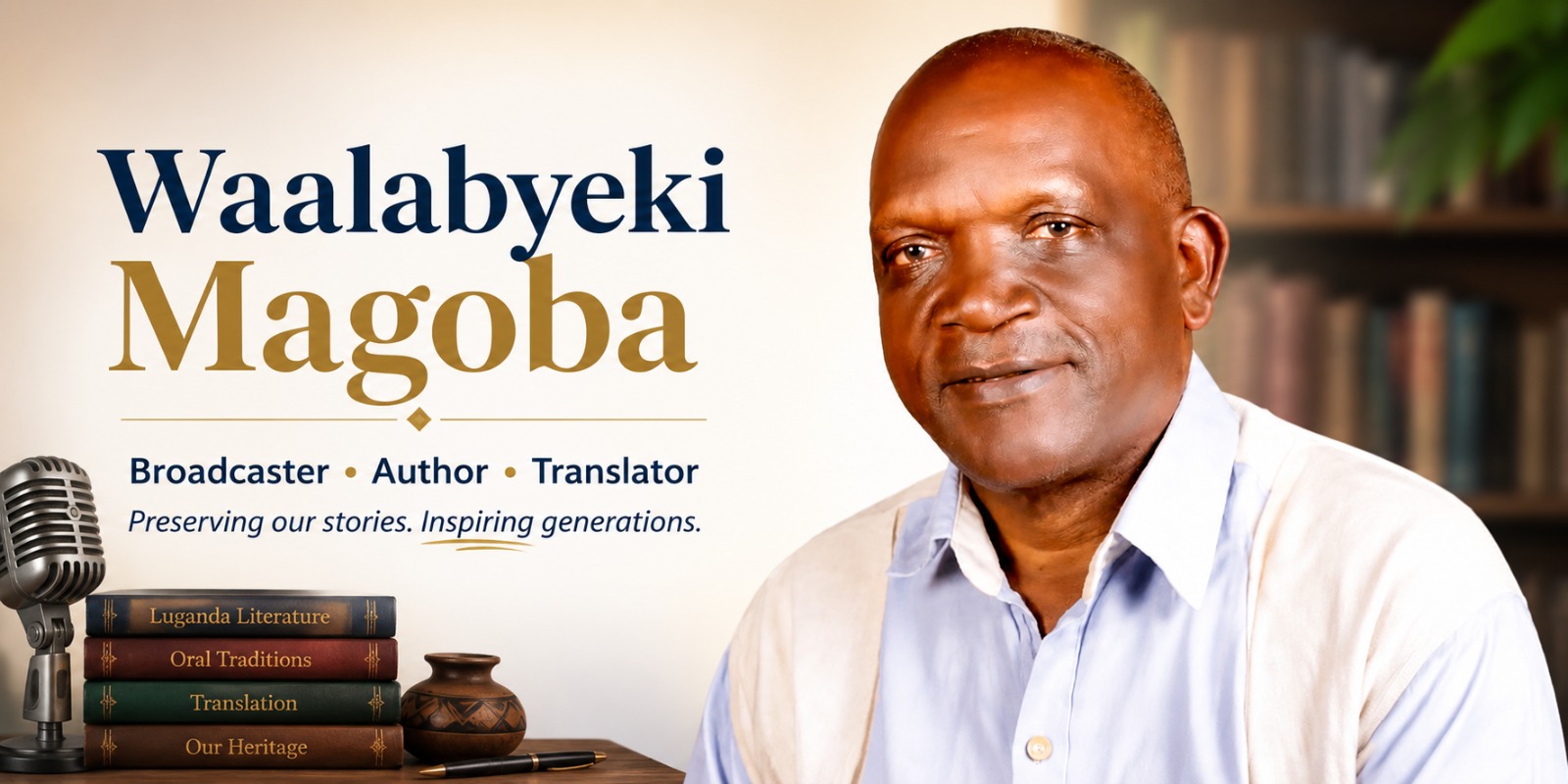
By Charles Batambuze
← Back to BlogI. The Crucible of Heritage
The lifelong crusade of Waalabyeki Magoba began as a deliberate, defiant stand against a pervasive post-colonial skepticism, specifically the assumption that indigenous African languages, and Luganda in particular, were incapable of carrying the weight of serious, world-class literature. For nearly six decades, Magoba has stood as an intellectual guardian of his mother tongue, resisting the slow erosion of Buganda's cultural heritage and demonstrating that a language is only as limited as the imagination of its writers.
He did not embark on this literary battlefield in isolation. Rather, he was guided by the intellectual legacies of Buganda's literary ancestors, who set an enduring standard for subsequent generations. In the rhythmic verse and prose of Edward Kawere and Solomon Mpalanyi, the historical and folkloric records preserved by the pioneering ethnographer and statesman Sir Apollo Kaggwa, the lyrical and theological poetry of the Reverend Father Doctor Mbaziira, and the dramatic, socially charged theater of Byron Kawadwa and Wycliff Kiyingi, Magoba found his creative blueprint. Their collective works whispered a profound truth that would govern his entire career: in the journey of cultural preservation, one may delay, but time will not.
II. Childhood and the Fireplace (Ekyoto)
This profound relationship with the written and spoken word did not begin in academic libraries, but around the glowing embers of the traditional family fireplace, the Ekyoto. Magoba's boyhood in Uganda was shaped by an environment where Luganda was employed with eloquence, artistry, and deliberate precision. Storytelling was not merely a leisure activity; it was an educational institution and an inseparable part of daily life. This rich linguistic heritage manifested in formal poetry, musical compositions, the winding conversations of school holidays, and structured storytelling sessions.
At home, the family gathered around the hearth, absorbing narratives from elders who delivered their tales in a highly articulate, classical form of Luganda. These evening sessions were designed to impart universal and timeless virtues, such as integrity, compassion, honesty, kindness, fairness, hard work, and humility, while systematically cautioning against vices like theft, greed, indolence, lust, falsehood, and violence. The elders used anecdotes with clinical precision to drive home moral lessons, illuminating their delivery with a vast repertoire of proverbs, idioms, and oral sayings.
This oral tradition was reinforced at school, most notably by Magoba's Primary One teacher, Mr. Emmanuel Bwogi. An extraordinarily dramatic storyteller, Bwogi animated his lessons with expansive gestures and vivid facial expressions that kept his young pupils entirely engaged. Although his Primary Two and Primary Three teachers lacked Bwogi's performance-oriented flair, they possessed an equally valuable quality: an unyielding dedication to the preservation of Luganda literature. Together, these early mentors planted the seeds of Magoba's lifelong vocation.
III. The Disruption of 1955 and the Transition to Radio
The traditional, intimate world of Magoba's childhood underwent a major technological shift in 1955 when his father purchased the family's first-ever radio set. Almost overnight, this technological marvel altered the domestic dynamic, silencing the voices of the elders around the hearth. The cherished evening storytelling gatherings were gradually replaced by news bulletins, foreign and local music, sports programming, and radio dramas.
The radio was a British-made PYE, grey in colour. To buy it, the entire family grew sorghum, which was harvested, dried, and sold for East African Shillings 300. Dad travelled to Kampala with the entire amount, leaving behind a family full of high expectations and excitement.
He bought the radio at Sultan's Shop, run by a wealthy Indian businessman, just opposite Nakasero Market. It was sold to him for Shs 218. We kept the receipt as a family memoir until, about ten years later, when Dad bought a bigger black PYE radio.
With the remaining money, Dad bought two pounds (latiri) of beef, two pounds of rice, a big loaf of bread, some sugar, and tea to celebrate the arrival of our mugole (the "bride"), as we affectionately called the new radio.
It was very prestigious for a family to own a radio set. While our dad was away in Kampala, we anticipated that our home would become the talk of the village because we were going to be the third home to possess a laadiyo, as it was popularly known.
When it arrived, my elder siblings tuned it as loudly as possible to alert the other village children that we had moved a step higher than their families. We now belonged to the prestigious and wealthy Laadiyo Club.
A few neighbours flocked to our home to listen to the news bulletins, birango (announcements), the weekly Okutunuulira Amawulire (news review programme), and the live Saturday football broadcasts.
The laadiyo was accompanied by a small black British-made Philips battery, which generated its power. Dad bought it for Shs 20 from the same money. Whenever its power dwindled, we used to take the baatule for recharging.
Decades later, Magoba would enter the broadcasting arena himself, determined to use the very medium that had disrupted his family's oral traditions to revive them on a national scale. He began his broadcasting career as a freelance presenter at Radio Uganda, the state-run national broadcaster established during the late colonial era. During those early years, financial compensation was minimal, and Magoba did not initially focus on developing an original artistic style. He was simply finding his voice within a vast, unseen broadcasting landscape, learning the technical constraints and possibilities of the medium.
IV. The Fires of the Airwaves: CBS and the Creation of Ekyoto
The turning point in Magoba's broadcasting career occurred in 1999 when he joined the Central Broadcasting Service (CBS), a commercial radio station established in 1996 under the patronage of the Buganda Kingdom. At CBS, Magoba found himself sharing the airwaves with formidable radio personalities like Abby Mukiibi and Kato Lubwama, who had captured the public's attention through highly engaging, theatrical programming.
To establish his own presence alongside these established broadcasters, Magoba realized he needed to carve out a distinct, intellectually rigorous niche. Relying on his deep grasp of Buganda's history and his extensive knowledge of Luganda proverbs, idioms, folk poems, and traditional puzzles, he designed a cultural program titled Ekyoto (The Fireplace). The program was a commercial and cultural success, re-establishing the traditional fireside storytelling experience within a modern, digital medium.
To maintain the quality and aesthetic appeal of Ekyoto, Magoba maintained a rigorous, seven-day work schedule. Committed to avoiding mediocrity, he spent his weekdays researching historical archives, writing scripts, and conducting detailed rehearsals. For each weekend broadcast, he wrote a brand-new, five-minute radio play based on folktales. He sourced diverse folktales from international libraries via the internet, adapting them to align with local cultural contexts, and hired professional actors to perform them.
Magoba recorded every broadcast, reviewing the tapes immediately afterward to identify and correct any performance flaws. Once a year, to mark the Kabaka's (King of Buganda) coronation anniversary, Magoba partnered with a highly skilled traditional Kiganda music composer from Masaka to write and produce a twenty-minute, non-stop radio musical play celebrating the life and achievements of one of Buganda's historical monarchs. Over his career on the radio, Magoba shared approximately 406 folktales and produced 200 original stories and plays for the airwaves.
V. Print Publics: Entanda ya Buganda and the Challenge of Literacy
The success of the Ekyoto radio program naturally paved the way for print-based creative endeavors. At the conclusion of a highly rated broadcasting season, Magoba proposed compiling the show's cultural quiz questions into a book. By late 2014, he suggested expanding this concept into a monthly Luganda-language magazine titled Entanda ya Buganda (The Provisions of Buganda).
The management of CBS endorsed the venture, appointing Magoba as its founding editor. Beginning with a modest print run of 3,000 copies, the magazine's circulation grew to 24,000 copies per run by the time of his retirement. In a society where reading habits were often limited to academic textbooks, this growth represented a significant milestone in vernacular publishing.
To broaden the magazine's appeal and maintain high readership, Magoba curated diverse content, featuring practical articles on agriculture, public health, regional history, fashion, culinary arts, sports, education, and family affairs. The articles were written in an accessible yet polished style, designed to serve as a long-term resource for personal growth and literacy across generations.
VI. Writing for the Next Generation: Children's Literature and Setbacks
Despite these successes, Magoba's literary mission faced significant challenges. In 2006, he convinced CBS to launch a children's version of the magazine, titled Entanda y'Abato (The Provisions of the Young). Despite setting an accessible cover price of 2,000 Ugandan Shillings, the publication eventually ceased production.
The magazine's decline highlighted deep-seated systemic barriers. Primary school teachers, accustomed to rigid curricular structures, preferred to stick strictly to government-prescribed textbooks rather than integrating supplementary reading materials. Furthermore, many parents did not see the long-term value in investing financial resources in a vernacular literary magazine for their children, prioritizing English-language materials instead.
Rather than discouraging him, this setback deepened Magoba's commitment to cultivating childhood literacy. To date, he has authored 40 books specifically designed for young readers, spanning poetry, history, novellas, and plays, with several more currently in development.
To foster a broader reading culture, he has organized numerous children's literature festivals and book fairs across Central Uganda. Beyond his creative writing, Magoba became a sought-after developmental consultant for aspiring authors. He is frequently invited by secondary schools to lecture on his texts, several of which have been selected for the national literature syllabus by the Ministry of Education.
VII. National Recognition and the International Stage
Magoba's contributions to Ugandan literature received formal recognition relatively early in his career. His work was twice recognized with National Literary Awards by the Uganda National Cultural Centre Drama Club (UNCDC), an institution established in the post-independence era to foster national theater and cultural expression. In 1977, he won the Best Script Award for his play Zonna Mpayippayo (All is Lost), and in 1981, he received a Special Award for Amazina g'Ebikulejje (The Dance of the Ogres), which was recognized as the first full-length multilingual musical play in Uganda's theater history.
These awards provided significant encouragement, reinforcing his commitment to writing. Following this national recognition, Magoba received invitations and travel funding to participate in international academic seminars and UNESCO literacy conferences in Dar es Salaam, Stockholm, Addis Ababa, Ben-Gurion University of the Negev in Israel, and the Frankfurt Book Fair. At these international forums, he presented papers advocating for community-based, vernacular literacy initiatives.
These global engagements reinforced his belief that dedicating his career to the Luganda-speaking community was both artistically and socially vital. These experiences affirmed that promoting his mother tongue was not merely a professional choice, but an essential aspect of cultural identity. He adopted the traditional Kiganda proverb as his guiding philosophy: "Kannabubwo: takirwa", meaning, "There is nothing superior to that which is your own."
VIII. Translation Work: Aesop and Global Biographies
In 1983, Magoba joined Akademe ya Luganda Ltd by Guarantee, an association dedicated to expanding access to knowledge for individuals literate primarily in Luganda. The organization encouraged its members to translate major foreign texts so that English or French would not remain barriers to global literary and scientific knowledge.
Magoba's initial contribution to this effort was translating Aesop's Fables, compiling 144 stories into a single Luganda volume. He chose Aesop because the allegorical nature of the fables closely mirrored the pedagogical style of traditional Kiganda oral storytelling, offering timeless moral lessons on human nature and ethics. He self-published the booklet, and the initial print run of 5,000 copies sold out within a short period.
The first Luganda translations of Aesop's fables were published between 1994 and 1996 in a series of seven booklets titled Seka nga bw'Oyiga, Volumes 1–7. The series was well received and became popular among Luganda readers.
Between 2023 and 2024, Magoba published three more collections of Aesop's works under different titles: Omuwambe, Ekijjulo Ekiwuniikiriza, and Omugole Eyabba Emmese, continuing his mission of making these timeless stories accessible to new generations of Luganda readers.
Encouraged by this success, and seeking to capture the interest of younger, contemporary readers, Magoba translated the biographies of several globally prominent and politically complex figures into Luganda. His translated biographies included the lives of Princess Diana, Saddam Hussein, Muammar Gaddafi, Pablo Escobar, Carlos the Jackal, and Monica Lewinsky. The strong sales of these books confirmed that introducing contemporary, high-interest international narratives was an effective strategy for developing a new generation of active vernacular readers.
IX. The Commercial Realities of Mother-Tongue Publishing
Despite his individual successes, Magoba's career highlights the severe economic difficulties of vernacular publishing in East Africa. The market for Luganda-language literature remains small, and the risk of financial loss is a constant challenge for authors. Established multinational and local educational publishing houses frequently decline creative manuscripts in indigenous languages, advising authors to submit their work to the National Curriculum Development Centre (NCDC), the statutory body mandated to design school curricula, for vetting as school textbooks.
However, the NCDC's evaluation process presents a significant hurdle for self-funded writers. The institution does not evaluate raw manuscripts; instead, it requires authors to submit fully printed, bound books for curriculum consideration. This requirement forces writers to bear the entire financial risk of typesetting, illustration, and printing without any guarantee of curricular approval.
Furthermore, commercial banks routinely reject loan applications for vernacular literary projects, classifying creative publishing as a high-risk venture. This leaves authors with few options other than turning to informal, predatory money lenders or relying on very limited personal savings, which severely restricts the scale and physical quality of self-published books.
X. Systemic Decay and Educational Advocacy
This economic crisis is compounded by systemic weaknesses within Uganda's primary and secondary educational frameworks. Magoba observes that only one Primary Teacher Training College in the country actively trains instructors to teach in local languages. Consequently, the vast majority of primary school teachers tasked with implementing national mother-tongue education policies have received no formal training in vernacular pedagogy, grammar, or orthography.
As a result, many schools choose to bypass mother-tongue instruction entirely. This creates a generation of students who are semi-literate in English and functionally illiterate in their own mother tongues.
Furthermore, socio-economic class dynamics complicate the preservation of local languages. Many middle-class and elite parents actively discourage schools from teaching local languages, arguing that vernacular instruction detracts from English fluency, which they view as the sole currency of global commerce and social mobility. While a child's fluency in English is celebrated as a marker of high social status, fluency and eloquence in Luganda rarely receive equivalent social validation in urban centers.
While Magoba welcomed the NCDC's policy directives to prioritize mother-tongue instruction in lower primary classes, he warns that without a major, coordinated training program for teachers in national colleges and universities, these policies will remain ineffective. He advocates for the Ministry of Education to strengthen its school inspectorate to ensure that local language classes are taught regularly and professionally. Additionally, he proposes establishing regional writing, debating, and drama competitions in indigenous languages to encourage students to take pride in their linguistic heritage.
XI. The Digital Fireplace: Future Horizons
Looking toward the future, Magoba finds promise in the emergence of digital media. While traditional storytelling was historically confined to the physical fireplace, limited by geography, physical space, and time, digital platforms allow oral and written narratives to transcend these boundaries, making them globally accessible.
Because many modern, urban parents did not grow up with the tradition of fireside storytelling, digital platforms are beginning to fill this cultural gap. Magoba is encouraged by the growing presence of high-quality Luganda literature, poetry, and historical analysis across social media, where a younger generation of Ugandans is actively using the language to engage with pressing contemporary political and social issues.
However, Magoba acknowledges the challenges of this digital transition. The historical accuracy of narratives shared on digital platforms is often variable, a vulnerability inherent to oral histories, where a narrator can easily alter or romanticize historical facts. Nonetheless, he believes that active participation in digital spaces must be prioritized over absolute historical precision for the time being, as digital visibility is essential for the survival of the language.
He views the work of contemporary Ugandan writers with optimism, pointing to authors such as Glaydah Namukasa, who writes in English, and Andrew Damba, who writes in Luganda, as promising standard-bearers for the future of Ugandan literature.
XII. The Anatomy of His Literary Oeuvre
Over his long career, Magoba has maintained a deep commitment to his entire literary catalogue, which comprises 114 distinct book titles. To him, the process of writing and publishing is akin to childbirth: a period of intense creative struggle followed by the lasting satisfaction of knowing that the resulting work will travel and stimulate minds.
Several of his works stand out as key milestones in his creative development:
- Volongoto (The Chaos): Magoba wrote this novella after witnessing primary school children teasing a classmate because of her minority ethnic background. The book was specifically designed to teach young readers the importance of diversity, tolerance, and hospitality toward strangers.
- Namulanda: This play, which won the prestigious 2021 JANZI Award, established to recognize outstanding achievements in Uganda's creative arts, took 13 years of detailed research and rewriting to complete. At one point in its long development, Magoba discarded and completely rewrote three-quarters of the manuscript to ensure its historical and emotional accuracy.
- Olina Omululu Naawe? (Are You Also Greedy?): This children's book recounts a humorous, semi-autobiographical story from Magoba's childhood. It details the creative tricks he and his siblings devised to deter an uninvited, persistent neighbour who routinely arrived to share their family's Sunday meals.
- Zaabike (The Reckless Race): Published in 2024, this political novel addresses the history of Ugandan electoral cycles from 1961 to the present day. It depicts the recurring patterns of electoral violence, administrative corruption, and political instability that have characterized these periods, concluding with a creative proposal to temporarily suspend elections in favor of a structured, comprehensive national dialogue.
XIII. Legacy: The Tortoise's Path
Ultimately, his decades as a storyteller, broadcaster, and advocate have taught Magoba profound lessons about both life and art. He views fables and literary fantasies as delicate, brief reflections of the larger drama of human existence, charming bubbles that capture our attention momentarily before dissolving. Recognizing that human life is similarly brief, he remains determined to use his remaining years to write, leaving behind a clear, accessible record of his culture.
He compares his life's journey to the tortoise of traditional folklore, which won its race not through speed, but through quiet persistence and determination. In his creative work, Magoba maintains an empirical approach to writing: he believes that a story's moral message should be woven naturally into the narrative rather than delivered as a rigid, heavy-handed sermon. He prioritizes creating believable, well-rounded characters whose dialogue reflects genuine human experience.
Guided by his lifelong personal motto, "Produce the best or nothing," Magoba's primary hope is that future generations of readers will remember him not only for the specific stories he preserved, but for the beauty, depth, and eloquence of the Luganda language in which he chose to tell them.
Charles Batambuze is the Executive Director of the Uganda Reproduction Rights Organisation (URRO) and a Policy Strategist specializing in the Culture and Creative Industries (CCI).